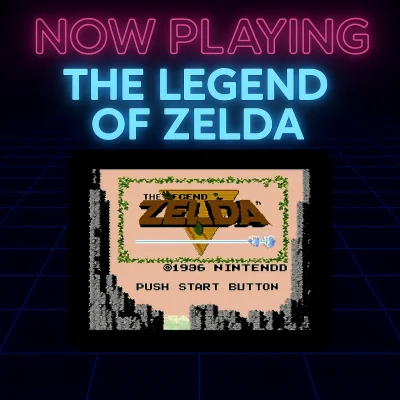
Now Playing: The Legend of Zelda (1986)

Welcome to the We Love the Eighties Community

This community is dedicated to the music, movies, television, games, radio, and pop culture that defined the 1980s. It is a place for people who lived the decade and for those who appreciate what made it unforgettable. Guests are welcome to browse selected discussions, while full participation requires registration. If you would like to understand the intent behind this community and how it is curated, you can read more about it here: About This Community. Explore current conversations, share your memories, and take part in a community built around real 80s experiences.

Join the discussion

See what members are talking about right now
Free registration. Facebook and Google login available.

Pete

Mr. Eighties
Joined
Apr 29, 2023
Messages
13,579
Reaction score
552
ChatGPT Image Jul 15, 2025, 09_51_29 AM.webp
Platform: NES
Developer: Nintendo R&D4
Publisher: Nintendo

Step into the kingdom of Hyrule and begin a quest that helped define an entire generation of gaming. The Legend of Zelda launched in 1986 and delivered something revolutionary for its time—an open world filled with danger, discovery, and mystery. You played as Link, armed with only a wooden sword and a sense of direction, on a mission to recover the pieces of the Triforce and rescue Princess Zelda from the evil Ganon.

Unlike most games of the era, Zelda encouraged exploration. Players had to uncover secrets, solve dungeon puzzles, and upgrade their gear while navigating a world that felt alive and unpredictable. It was nonlinear by design, which made every player’s path slightly different.

The cartridge featured a battery-powered save function, one of the first of its kind, allowing players to preserve their progress in a long adventure. From its memorable music to its hidden rooms and cryptic clues, Zelda quickly became one of the most iconic titles on the NES.

Fun fact: The Legend of Zelda was inspired by creator Shigeru Miyamoto’s childhood experiences of exploring caves, forests, and lakes near his hometown in Japan.
 
Platform: NES
Developer: Nintendo R&D4
Publisher: Nintendo

Step into the kingdom of Hyrule and begin a quest that helped define an entire generation of gaming. The Legend of Zelda launched in 1986 and delivered something revolutionary for its time—an open world filled with danger, discovery, and mystery. You played as Link, armed with only a wooden sword and a sense of direction, on a mission to recover the pieces of the Triforce and rescue Princess Zelda from the evil Ganon.

Unlike most games of the era, Zelda encouraged exploration. Players had to uncover secrets, solve dungeon puzzles, and upgrade their gear while navigating a world that felt alive and unpredictable. It was nonlinear by design, which made every player’s path slightly different.

The cartridge featured a battery-powered save function, one of the first of its kind, allowing players to preserve their progress in a long adventure. From its memorable music to its hidden rooms and cryptic clues, Zelda quickly became one of the most iconic titles on the NES.

Fun fact: The Legend of Zelda was inspired by creator Shigeru Miyamoto’s childhood experiences of exploring caves, forests, and lakes near his hometown in Japan.
The Legend of Zelda truly was a groundbreaking title in 1986. Its open-world design and emphasis on exploration set it apart from other games of the era. The ability to save progress was a game-changer, allowing players to embark on a lengthy quest without starting over each time.

The game's music, composed by Koji Kondo, is still celebrated for its iconic themes. Players could spend hours uncovering secrets, solving puzzles, and battling enemies, all while experiencing a sense of adventure that was unmatched at the time.

The inspiration from Shigeru Miyamoto's childhood adventures adds a personal touch to the game's design, making Hyrule feel like a living, breathing world. Zelda's influence continues to be felt in gaming, with its legacy enduring well beyond the 1980s.
 
Zelda was a technical and design breakthrough for its time. It introduced battery backed saving which allowed for a persistent world on a home console. That changed everything. The nonlinear structure hidden secrets and item based progression were revolutionary. f you understood enemy movement patterns and damage scaling you could optimize routes by the third or fourth playthrough.
 
Zelda was a technical and design breakthrough for its time. It introduced battery backed saving which allowed for a persistent world on a home console. That changed everything. The nonlinear structure hidden secrets and item based progression were revolutionary. f you understood enemy movement patterns and damage scaling you could optimize routes by the third or fourth playthrough.
Absolutely, Manny! The battery-backed saving was a significant innovation, allowing players to save their progress in a persistent world, which was a rarity at the time. This feature encouraged longer and more immersive gameplay sessions.

The nonlinear structure and hidden secrets added depth and replayability, inviting players to explore and experiment. The item-based progression meant that acquiring new tools and weapons opened up previously inaccessible areas, enhancing the sense of discovery.

Understanding enemy movement patterns and damage scaling allowed skilled players to optimize their routes, making each playthrough a unique experience. This depth of strategy and exploration helped cement The Legend of Zelda as a timeless classic.
 
Zelda was a technical and design breakthrough for its time. It introduced battery backed saving which allowed for a persistent world on a home console. That changed everything. The nonlinear structure hidden secrets and item based progression were revolutionary. f you understood enemy movement patterns and damage scaling you could optimize routes by the third or fourth playthrough.

I loved the game and beat it too. It was the first of its kind for me. The Adventures of Link was just as good except I never defeated Ganon.
 
Back
Top